
Your pediatrician's "wait and see" approach doesn't have to be your only option when your gut tells you something is different about your child's growth. It's completely natural to feel a mix of confusion and anxiety when you start searching for an infant screening near me San Jose. You might worry that seeking a specialist evaluation means labeling your baby too early, or you might simply feel overwhelmed by the complex referral web in Santa Clara County. We understand that this journey feels heavy, and we want you to know you don't have to walk it alone.
We believe that every parent deserves a clear path to understanding their child's unique development. In this guide, you'll discover how to distinguish between a standard wellness check and a specialized multidisciplinary screening. We'll provide a clear roadmap of local options in San Jose and explain how the right support team can turn uncertainty into a proactive plan for your child's future. You'll learn about the benefits of early intervention and how to access the expert guidance your family needs to thrive. This is about more than just milestones; it's about finding a partner who values your child's potential as much as you do.
Key Takeaways
- Understand why early intervention is vital for your child's brain plasticity and how to move past the "wait and see" approach.
- Learn how a multidisciplinary assessment brings together specialists in cognitive, social-emotional, and communication domains to provide a complete picture of your infant's growth.
- Navigate the local landscape when searching for an infant screening near me San Jose, comparing public referral paths with private, specialized programs.
- Access a practical checklist to help you prepare for an evaluation, from gathering daily observations to choosing the right comfort items for your child.
- Discover how a family-centered approach provides a supportive "safe harbor" for parents while delivering professional clinical expertise.
Understanding Infant Screening in San Jose: Why Early Action Matters
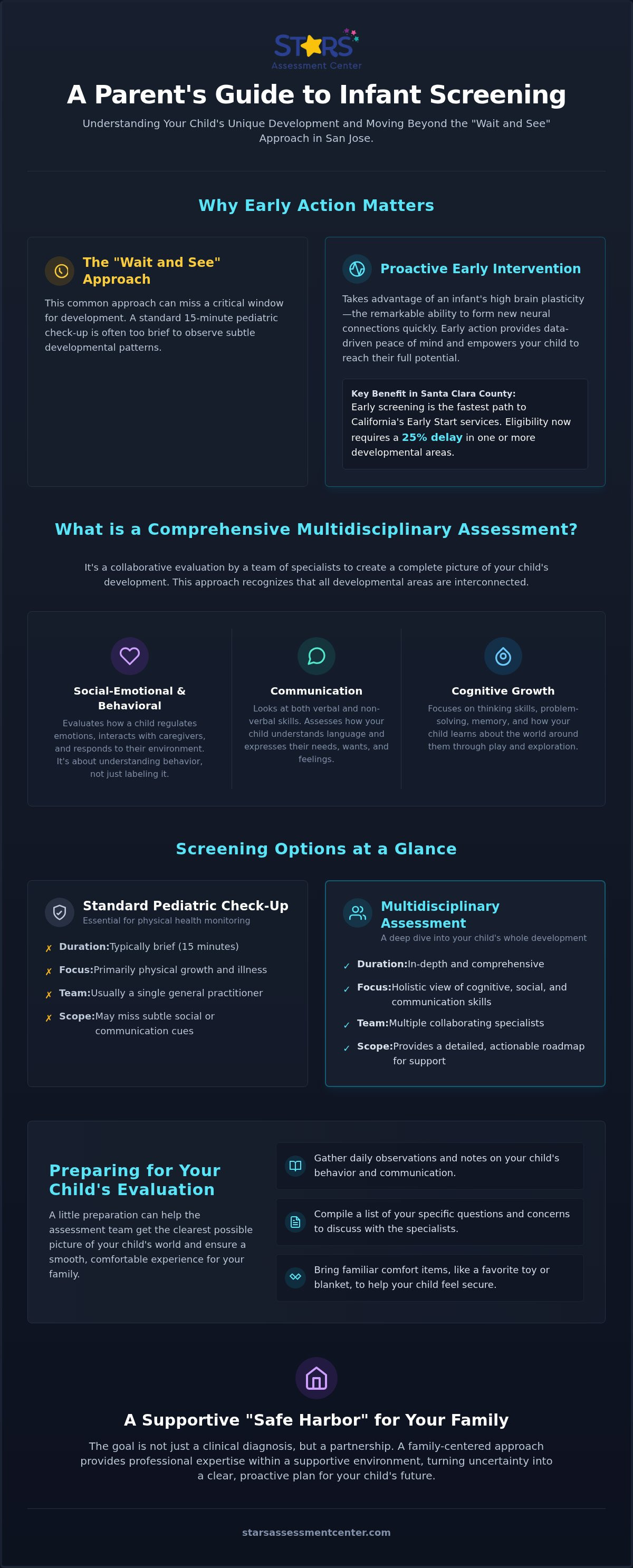
When you start looking for an infant screening near me San Jose, it's often because you've noticed a small detail in your child's behavior that you can't quite name. Developmental screening isn't a test your child passes or fails. Instead, it's a proactive tool designed to map out your infant's unique growth patterns. While many families are familiar with initial newborn screening programs that check for immediate health concerns at birth, developmental screening takes a broader look at how your child interacts, moves, and communicates during their first three years.
There is a long-standing debate between the "wait and see" approach and seeking early intervention. Science tells us that an infant's brain is incredibly plastic; it has a remarkable ability to form new connections quickly. By choosing early action, you're taking advantage of this window of high brain plasticity. In San Jose, where our community is rich with multicultural and linguistic diversity, understanding these patterns early helps ensure that every child receives the specific support they need to thrive. We view a specialized assessment center as a "safe harbor" where families can find clarity, partnership, and professional warmth rather than just a clinical diagnosis.
The Difference Between Medical and Developmental Screening
A standard pediatric check-up is essential for monitoring your baby's physical health, but these visits are often brief. A 15-minute appointment might not be enough time for a doctor to observe subtle social-emotional cues or complex communication patterns. This is where a multidisciplinary developmental assessment differs. While medical screenings look for illness or physical growth, developmental evaluations involve a team of experts looking at the whole child. These specialized centers provide a deeper look at cognitive and physical milestones that a general practitioner might miss in a busy office setting.
Early Intervention Benefits in Santa Clara County
Early screenings are the fastest way to access California’s Early Start services. In Santa Clara County, the eligibility criteria for early intervention services changed in 2022, now requiring a 25% delay in one or more developmental areas. Identifying these needs early has a direct impact on long-term school readiness. Data from the 2025 Santa Clara County Kindergarten Readiness Assessment shows that children who receive early support enter the classroom with significantly stronger foundational skills. For San Jose parents, this process isn't just about finding a label. It's about gaining data-driven peace of mind and empowering your toddler to reach their full potential through expert guidance.
The Components of a Comprehensive Multidisciplinary Assessment
When you search for an infant screening near me San Jose, you want more than a simple checklist of milestones. You need a team that sees your child as a whole person. A multidisciplinary approach means that various specialists, including experts in social-emotional health, communication, and cognitive growth, collaborate to observe your child. Having multiple experts in one room is vital because developmental areas are deeply connected. A delay in speech might actually stem from a social-emotional barrier or a physical motor issue. By looking at these domains together, we ensure nothing is missed.
For children under three, specialized screenings for Autism and Down syndrome are particularly important. These assessments don't just look for deficits; they identify how your child learns best and how they process the world around them. Once the evaluation is complete, the team synthesizes the findings into a family-centered roadmap. This isn't a cold clinical report. It's a guide that translates data into actionable steps for your daily life in Santa Clara County. If you're ready to start this journey, a multidisciplinary developmental assessment can provide the clarity and partnership your family deserves.
Social-Emotional and Behavioral Evaluation
Parents often worry that their child's intense reactions are just "tantrums," but a social-emotional assessment looks deeper. We evaluate how a toddler regulates their emotions and how they interact with caregivers in familiar San Jose settings like local parks or at home. Identifying a social-emotional delay early isn't about labeling your child. It's about understanding their internal world. Our experts look at how they seek comfort, how they share joy, and how they handle transitions. This helps distinguish between typical toddler behavior and a need for targeted support.
Speech, Language, and Communication Milestones
Specialists focus on two main areas: receptive language, which is what your child understands, and expressive language, which is what they say or gesture. It's common for parents to wonder if their child is just a "late bloomer." Our experts use standardized tools and clinical observation to distinguish between a temporary pause in growth and a true communication delay. Since early communication skills are the foundation for future social-emotional health, getting an accurate picture before age three is essential. We look at non-verbal cues, eye contact, and the intent to communicate, ensuring your child has the tools to express their needs clearly.
Comparing Local Assessment Options in Santa Clara County
Finding the right infant screening near me San Jose involves choosing between the public system and private specialized programs. Most families start with a referral to the San Andreas Regional Center (SARC), which serves as the gateway for California’s Early Start program. Federal law requires primary care physicians to refer children under age three for evaluation within two business days of identifying a potential need. While the public pathway provides essential services at no cost, the high demand in Santa Clara County can sometimes lead to a process that feels more bureaucratic than personal.
Contrast this with private assessment programs like Stars Assessment Program. These programs offer a more intimate, multidisciplinary setting where specialists spend extensive time observing your child’s social-emotional and cognitive patterns. The choice depends on the level of depth and personal support your family needs. If your child has specific concerns related to Autism or Down syndrome, the comprehensive nature of a private multidisciplinary team often provides a clearer, faster roadmap for growth. This path allows for a more nuanced look at your child's development, moving beyond simple checklists to provide a deep understanding of their unique strengths.
Accessing Services in San Jose and Milpitas
Our local geography plays a big role in how you access care. Whether you're near the tech hubs of Milpitas or the residential neighborhoods of South San Jose, support is available. The reach of specialized care extends from the northern parts of Santa Clara County down through Morgan Hill and even into Salinas. In a diverse region like Silicon Valley, cultural sensitivity isn't just a bonus; it's a necessity. A local provider should offer support that respects your family’s background and language, ensuring that the assessment process feels inclusive and clear for everyone involved.
What to Look for in a Local Specialist
When choosing a specialist, look for a team rather than a solo practitioner. A multidisciplinary group brings together different lenses to view your child's growth. It's also essential to find a provider who values a family-centered approach. This means they don't just look at data; they listen to your intuition as a parent. You know your child best, and your observations are a critical part of the assessment. Finally, ask about follow-up resources. A good specialist won't just hand you a report; they'll provide guidance on early intervention steps and connect you with the right support for your child's next chapter.
Preparing for Your Child’s Evaluation: A Local Parent’s Checklist
Preparing for a developmental evaluation is as much about emotional readiness as it is about logistics. When you've spent weeks searching for an infant screening near me San Jose, the actual appointment can feel like a major milestone. To make the day go smoothly, start by gathering your child's medical records and any notes from your pediatrician. On the day of the assessment, bring items that help your child feel secure. A favorite stuffed animal, a specific comfort blanket, and familiar snacks can help your little one feel at ease in a new environment. Since these evaluations often last between one and two hours, having a few quiet toys and a change of clothes is also a smart move.
Managing the emotional journey is just as important as the physical preparation. It's natural to feel protective or anxious about what the results might show. Talk openly with your partner or family members about these feelings before the appointment. Remind yourselves that this screening is a proactive step toward providing the best possible support for your child's growth. During the session, you should feel empowered to ask the specialists direct questions. Consider asking, "What specific social-emotional strengths did you see today?" or "How do these play-based observations translate into daily goals?" If you're feeling unsure about the next steps, you can reach out to our specialists to discuss how to best prepare for your family's visit.
Documenting Your Concerns
Before your appointment, start a simple "milestone log" of your child's daily habits at home. Record specific observations about their interactions, such as how they make eye contact or how they respond to their name. It's helpful to note what triggers frustration and, conversely, what leads to a successful social-emotional connection. To help the multidisciplinary team see your child’s full personality, write a single sentence that summarizes their greatest strengths. For example: "My child has a wonderful sense of humor and loves to share their favorite books with me." This ensures the team sees the vibrant individual behind the clinical data.
What Happens During the Screening Appointment
A typical assessment day at a San Jose center is designed to be gentle and non-intimidating. Specialists use play-based evaluation techniques, observing your child as they engage with age-appropriate toys and games. This approach allows the team to see your child's natural cognitive and communication skills without the pressure of a "test" environment. You aren't just a spectator in this process; you're an active contributor. The team will often ask you to demonstrate how your child accomplishes tasks at home or to provide context for behaviors they see during the session. This partnership ensures the final roadmap is accurate and deeply rooted in your child's real-world experiences.
Why Families Trust Stars Assessment Program in San Jose
Choosing a provider for an infant screening near me San Jose isn't just about finding a clinic; it's about finding a partner who understands the weight of your concerns. Stars Assessment Program has served Santa Clara County families since 1988 through the Stars Behavioral Health Group (SBHG). This long legacy of empathy means we don't just see a set of symptoms. We see your whole child. Our multidisciplinary team works together to ensure that every evaluation is conducted with professional warmth and clinical precision. We specialize exclusively in the birth to age three window because we know these years are the most critical for developmental growth. By focusing on this specific age group, our specialists maintain a deep, nuanced understanding of the milestones that matter most during these formative years.
Our "Safe Harbor" philosophy is at the heart of everything we do. We believe that a clinical evaluation shouldn't feel cold or bureaucratic. Instead, we've created an environment that feels like a steady ally for parents. When you walk through our doors, you're met with a team that values your intuition and respects your family's unique journey. This partnership allows us to provide a level of care that goes beyond a standard medical check-up, offering you the clarity and hope you need to support your child's early progress.
Expertise in Social-Emotional and Autism Screenings
Detecting early signs of Autism or Down syndrome requires a specialized, gentle touch. We focus on the social-emotional and communicative nuances that define a child's early experience. We understand that receiving a new diagnosis carries immense emotional weight for parents. Because of our integrated behavioral health background, we're uniquely equipped to support you through this transition. We offer a "safe harbor" where your questions are answered with patience and your child's potential is always the primary focus. Our approach ensures that families feel heard and validated. We believe that a supportive environment is essential for both the child's comfort and the parent's peace of mind during the screening process.
Next Steps After Your Assessment
An assessment is only the beginning of your child's journey. We are committed to bridging the gap between the initial screening and the start of early intervention services. Whether you live in San Jose, Milpitas, or Salinas, our goal is to ensure you never feel lost in the process. We provide the clarity you need to move forward with confidence, helping you understand the local referral landscape with ease. Our expertise allows us to translate complex clinical findings into practical, everyday strategies for your family. If you're ready to take the next step toward understanding your child's growth, you can schedule a consultation with our San Jose team today. We are here to guide you every step of the way.
Moving Forward With Confidence for Your Child's Growth
Navigating your child's early development doesn't have to be a journey you take alone. By choosing a proactive path, you're giving your infant the benefit of early intervention during their most critical window of brain plasticity. You now understand that a comprehensive screening is more than just a medical check; it's a collaborative look at their social-emotional, cognitive, and communicative world. Whether you're just beginning to look for an infant screening near me San Jose or are ready to move forward from a pediatrician's referral, having a clear roadmap makes all the difference.
At Stars Assessment Program, our multidisciplinary team of developmental experts is dedicated to providing the specialized birth-to-three focus your family deserves. We believe in empathetic, family-centered care that respects your intuition and prioritizes your child's unique potential. You have the tools to prepare, the knowledge to choose the right local path, and a partner ready to guide you through every milestone.
Begin your child’s journey with a compassionate assessment in San Jose and find the "safe harbor" your family needs to thrive. Your child’s brightest future starts with the clarity you find today.
Frequently Asked Questions
How do I know if my infant needs a developmental screening?
You should consider a screening if you notice your child isn't meeting expected milestones in communication, social interaction, or motor skills. Common signs include a lack of eye contact, not responding to their name, or delays in babbling. While every child grows at their own pace, your intuition as a parent is a powerful tool. A professional screening helps determine if these patterns are typical or if your child could benefit from extra support.
Is infant screening covered by insurance in California?
Most private insurance plans in California cover developmental screenings as part of preventative care. Additionally, the California Early Start program ensures that evaluations and assessments are provided at no cost to families if a child is at risk for a developmental delay. We recommend checking with your specific provider to understand your coverage details. Our team can also help you navigate these options when you search for an infant screening near me San Jose.
What is the difference between a screening and a full evaluation?
A screening is a brief preliminary check used to identify if a child is at risk for a developmental delay. It's often the first step in the process. A full evaluation is much more comprehensive, involving a multidisciplinary team that looks deeply at social-emotional, cognitive, and physical domains. While a screening tells us if there's a concern, an evaluation provides a detailed roadmap and a specific plan for your child's growth.
Do I need a doctor’s referral for an assessment at Stars?
You don't always need a formal doctor's referral to begin a conversation with us. Many parents reach out directly when they have concerns about their child's development. However, if you are seeking services through the San Andreas Regional Center or certain insurance providers, a referral from your pediatrician is often required to move forward with a full multidisciplinary assessment. We can guide you through the specific requirements for your situation during your first call.
How long does a multidisciplinary assessment typically take?
A typical multidisciplinary assessment usually takes between one and two hours. We design these sessions to be play-based and low-stress, allowing our specialists to observe your child in a natural, comfortable setting. This timeframe ensures we have enough data to see the "whole child" across different domains like communication and social-emotional regulation. We encourage you to bring snacks and comfort items to help your little one feel at home throughout the process.
What happens if the screening shows my child has a delay?
If an assessment identifies a developmental delay, we work with you to create a clear, actionable plan. This often involves connecting your family with California’s Early Start services or specialized intervention programs. Finding a delay early is actually a positive step, as it allows us to utilize your child's brain plasticity to build new skills. You won't have to navigate these next steps alone; we act as your steady ally and guide.
Can you screen for Autism in infants under 18 months?
Yes, specialists can identify early markers of Autism in children well before they reach 18 months. We look for specific social-emotional cues, such as how an infant uses eye contact, gestures, and "joint attention" to share interests with others. While a formal diagnosis may come later, identifying these early communication patterns allows us to start supportive interventions during the most critical window of growth. Early detection is a key part of our family-centered approach.
How soon can we get an appointment in the San Jose or Milpitas office?
We strive to provide families with timely access to care because we know that waiting can be stressful. Appointment availability in our San Jose and Milpitas offices can vary, but we often prioritize new families who have immediate concerns. When you contact us, we'll discuss your specific needs and work to find the earliest possible opening. Our goal is to serve as a "safe harbor" that provides clarity without unnecessary delays.


