
You’re watching your toddler at the park, and while other children are playing together, your little one seems overwhelmed by the noise or struggles to move past a minor frustration. You wonder if this is just a phase or something more, but the thought of a "label" feels heavy and frightening. Seeking a social emotional assessment Santa Clara County parents can rely on is often the first step toward finding peace of mind and understanding your child's unique needs.
It’s completely natural to feel a mix of love, worry, and confusion when your child’s development doesn't follow a predictable path. You aren't alone in feeling overwhelmed by the complex web of county services and the clinical jargon that often follows. This process isn't about putting your child in a box; it's about opening a door to the right support and realizing you have a dedicated team in your corner.
This assessment provides the clarity you need to understand your child’s emotional world and creates a clear, actionable path forward for their growth. We’ll walk you through what to expect during an evaluation, how early intervention eligibility works, and how our local multidisciplinary team supports your family every step of the way.
Key Takeaways
- Learn why the "Birth to Three" window is the most vital time for early intervention and how it impacts your child's long-term emotional well-being.
- Discover the step-by-step journey of a professional social emotional assessment Santa Clara County families use to move from initial screening to a clear developmental roadmap.
- Gain the confidence to distinguish between typical toddler behaviors and genuine red flags that may indicate a need for specialized support.
- Understand the "Natural Environment" approach and how assessing your child in comfortable, familiar settings leads to more accurate and helpful results.
- Explore how the multidisciplinary team at the Stars Assessment Program provides a holistic view of your child’s growth, ensuring you receive comprehensive answers in one supportive place.
Understanding Social-Emotional Health in Santa Clara County Toddlers
When we talk about how a toddler grows, we often think of their first steps or their first words. However, there is a quieter, equally vital part of their growth happening beneath the surface. This is social-emotional development, which involves how children from birth to age three learn to express feelings, manage their impulses, and build meaningful relationships with the people around them. In the fast paced environment of Santa Clara County, where many families balance complex childcare transitions and diverse cultural traditions, understanding these early emotional foundations is essential for your child's long term well being.
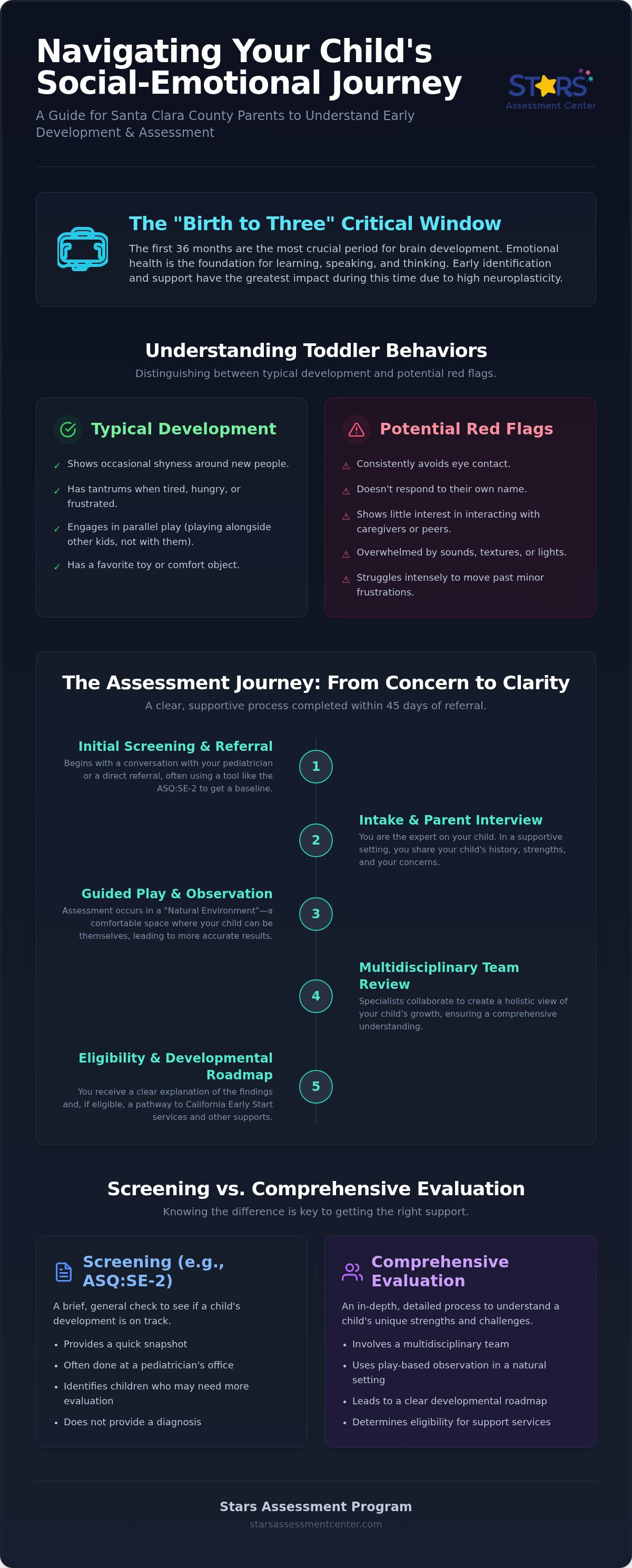
California’s "Birth to Three" window is widely recognized as the most critical period for a child's brain. During these first 36 months, the brain is incredibly flexible, forming millions of new neural connections every second. This means that emotional health isn't just a separate category of growth; it is deeply connected to how a child learns to speak, think, and eventually navigate a classroom. For families in San Jose, Milpitas, and surrounding areas, a professional social emotional assessment Santa Clara County specialists provide can offer a clear window into how a child is processing their world.
The Role of Social-Emotional Milestones
Every child develops at their own pace, yet there are key indicators that help us understand if their emotional growth is on track. We look for consistent eye contact, social smiling in response to a parent's face, and a child’s ability to respond when their name is called. These aren't just "cute" behaviors; they are signs that a child is connecting with their environment. Social-emotional health is the vital foundation upon which all early learning and cognitive development is built. We also pay close attention to self-regulation. This is a toddler’s ability to manage their "internal thermostat" when they feel frustrated or overwhelmed, which is a skill that begins to take shape in these early years.
Why Early Identification Matters
The concept of neuroplasticity tells us that the earlier we identify a challenge, the more effective our support will be. Waiting until a child reaches preschool can sometimes mean missing the window where intervention has the greatest impact. Many parents encounter the "wait and see" myth on community forums, where they are told their child will simply grow out of certain behaviors. However, seeking a social emotional assessment Santa Clara County families trust is a proactive way to replace uncertainty with a plan. These evaluations are the primary gateway to California’s Early Start services, ensuring your child receives the specific guidance they need during the years when their brain is most ready to learn and adapt.
The Professional Assessment Process: What Parents Can Expect
Moving from a quick screening at the doctor's office to a full clinical evaluation can feel like a significant leap for any family. While a general screening tool like the ASQ:SE-2 provides a helpful snapshot, a comprehensive social emotional assessment Santa Clara County families undergo is much more detailed and nuanced. This process prioritizes what we call a "Natural Environment" approach. We don't want to see how your toddler performs in a cold or intimidating setting. Instead, we observe them in spaces where they feel safe and comfortable, ensuring the results reflect their true daily life. You remain the most vital expert in the room. You know your child’s favorite toys, their unique fears, and their specific triumphs better than anyone else.
The timeline is designed to be efficient because we understand how much every month matters in early development. By law, the assessment and eligibility determination process must be completed within 45 days of referral. This ensures your family doesn't get stuck in a long waiting period during these critical early years. If you're feeling overwhelmed by the next steps, you can learn more about our supportive intake process to help you prepare for the evaluation day.
Step-by-Step Through the Evaluation Day
Your day begins with an initial intake where you share your child’s history and your primary concerns in a quiet, supportive setting. We listen closely to your story before moving into guided play and observation. To a toddler, this feels like a fun session with new toys, but our specialists are watching how they navigate challenges, seek comfort, and interact with others. We use standardized tools to gather data, but we balance these with clinical observation. This combination is necessary for accuracy because a test score alone can't capture the full complexity of a child's personality or their social potential.
The Multidisciplinary Team Approach
A social-emotional evaluation isn't the work of just one person; it's a collaborative effort. A developmental specialist observes social interactions, while a speech and language pathologist looks for "pre-verbal" emotional cues, such as how a child uses gestures or eye contact to communicate their needs. They look for specific Social-Emotional Red Flags that might be missed in a standard checkup. The multidisciplinary team at the Stars Assessment Program creates a 360-degree view of your child by combining insights from various developmental fields. This collaborative effort ensures that no detail is overlooked and that the path forward is tailored specifically to your child’s strengths.
Screening vs. Comprehensive Evaluation: Knowing the Difference
It’s easy to confuse a developmental screening with a full evaluation. A screening is a quick "snapshot" of your child's current skills, often performed by your pediatrician or at a local FIRST 5 Family Resource Center. These screenings usually involve a short questionnaire, like the ASQ:SE-2, where you answer questions about your child’s behaviors. While this is a great first step, it isn't designed to provide a diagnosis or a specific plan of care. It’s a tool to see if more investigation is needed.
In contrast, a comprehensive social emotional assessment Santa Clara County specialists provide is an in-depth study of your child’s world. This evaluation involves a multidisciplinary team observing your child in various scenarios to determine their eligibility for California’s Early Start services. Even if a screening comes back "negative" or within the normal range, your intuition as a parent is a powerful tool. If you feel something is being missed, a full evaluation can offer the thorough answers you deserve.
When a Screening Isn’t Enough
Sometimes, a questionnaire can’t capture the nuance of a child's social interactions. Parent-only forms have limitations because they rely on your observations within the home, which might differ from how a child acts in a new or social environment. If you notice "red flags" like a persistent lack of eye contact, extreme difficulty with transitions, or a child who doesn't seek you out for comfort, you don't have to wait for a screening to fail. You have the right to advocate for a full assessment to ensure your child’s needs aren't minimized by a simple checklist. We’re here to help you find the right words to request that deeper look.
Evaluating Specific Conditions: Autism and Down Syndrome
For specific conditions, a more specialized approach is necessary. For toddlers showing signs of Autism, we use tools like the M-CHAT (Modified Checklist for Autism in Toddlers) alongside clinical observation. This helps identify delays in joint attention or social reciprocity early on. For children with Down syndrome, social-emotional development often has its own unique profile, where a child might be very socially motivated but struggle with the cognitive processing required for complex play. In these cases, having a multidisciplinary team is essential. It allows experts from different fields to collaborate, ensuring that the final report isn't just a list of delays, but a holistic view of your child’s potential.
Identifying Social-Emotional Red Flags in Your Toddler
Every parent knows the "terrific twos" often involve big feelings and loud tantrums. It’s a normal part of testing boundaries. However, there is a difference between a typical toddler meltdown and significant emotional dysregulation. If your child’s emotional responses feel consistently out of proportion to the situation, or if they struggle to recover even with support, it may be time to look closer. A professional social emotional assessment Santa Clara County experts provide can help determine if these behaviors are developmental hurdles or signs of a deeper need.
Social withdrawal is another key area to watch. Most toddlers are naturally curious about the people in their world, even if they're a bit hesitant at first. A red flag occurs when a child doesn’t seek out others for comfort when they are hurt or doesn't seem interested in "showing" you their toys or achievements. This lack of social seeking can sometimes be mistaken for an "independent" personality, but it's often a sign that the child is struggling to build emotional bridges. Families in San Jose and Salinas can begin tracking these milestones through local FIRST 5 Family Resource Centers to see how their child compares to typical developmental timelines.
Atypical emotional responses are also common indicators. This might look like a child under-reacting to a scraped knee or over-reacting to common sensory stimuli like a vacuum cleaner or a change in lighting. If these patterns feel familiar, you can contact our team for a professional consultation to discuss your concerns in a safe, supportive environment.
Communication and Emotional Connection
One of the most important behaviors we look for is "joint attention." This is when your child points to a bird in the sky or a dog in the park specifically to make sure you see it too. They aren't just asking for something; they're sharing an experience. When this is missing, or when every minor transition in the daily routine causes a prolonged crisis, it may indicate a delay. While a shy child may eventually warm up to a new face, a child with a social-emotional delay often lacks the fundamental drive to connect or share experiences with others.
Behavioral Patterns to Monitor
We also pay attention to repetitive behaviors that might interfere with social bonding, such as spinning wheels on a car for long periods rather than "driving" it. Extreme difficulty with self-soothing beyond what is typical for their age is another indicator. These behaviors often look different in the comfort of a Milpitas or Gilroy home compared to a clinical setting. This is why our team prioritizes observing your child in their natural environment, where they feel most like themselves, ensuring we capture the most accurate picture of their daily life.
The Stars Assessment Program: Your Safe Harbor in Santa Clara County
We understand that the journey to understanding your child's needs can feel like navigating uncharted waters. The Stars Assessment Program is designed to be a safe harbor for families in San Jose, Milpitas, and the surrounding areas. When you seek a social emotional assessment Santa Clara County parents can trust, you aren't just getting a clinical report; you're gaining a partner. We believe in looking at the whole child, not just a specific delay or challenge. This multidisciplinary philosophy ensures that we see your toddler’s strengths, their unique personality, and their untapped potential alongside any areas where they might need extra support.
Our work doesn't happen in a vacuum, and we don't expect you to navigate the system alone. We collaborate closely with the San Andreas Regional Center and other local entities to ensure your family has a clear path forward. If you've been feeling overwhelmed by the bureaucracy of county services, our team helps bridge that gap. We provide the expert guidance needed to move from a place of uncertainty to a clear, actionable plan. When you speak with your pediatrician, you can confidently share that you're seeking a comprehensive social emotional assessment Santa Clara County specialists use to create tailored developmental roadmaps.
A Family-Centered Evaluation Experience
We've intentionally created a warm, non-clinical environment for toddlers in our Santa Clara facilities. We know that a child who feels safe and comfortable is more likely to show us their true self. This family-centered approach extends to you as well. We empower parents with clear, easy to understand reports and the emotional support you need to process the results. As part of the Stars Behavioral Health Group (SBHG), our mission is rooted in over 30 years of service and community care. We don't just provide a medical service; we offer a supportive community that values cultural sensitivity and personal connection.
Connecting to Early Intervention
A professional evaluation through the Stars Assessment Program is often the first step toward accessing California’s Early Start resources. These evaluations provide the necessary documentation to determine eligibility for specialized services that can make a lifelong difference. Whether you're in Morgan Hill, Salinas, or Santa Cruz, our team is dedicated to ensuring no family feels left behind. You don't have to wait for a crisis to reach out and ask for clarity. Contact the Stars Assessment Program today to begin your journey of understanding and give your child the foundation they deserve.
Empowering Your Child’s Future Today
Navigating your child’s early years often involves many questions, but you don't have to find the answers alone. Understanding the difference between typical toddler behavior and developmental red flags is the first step toward providing the support your little one needs. By choosing a professional social emotional assessment Santa Clara County families can rely on, you're building a bridge between uncertainty and a clear developmental roadmap. This process ensures your child has access to the vital resources offered through California’s Early Start program during their most formative years.
At the Stars Assessment Program, we bring over 30 years of behavioral health expertise through SBHG to every family we serve. Our multidisciplinary team of specialists works together to provide a holistic view of your child’s growth within our family centered "Safe Harbor" environment. We're here to listen, support, and guide you toward the best possible outcomes for your child’s future.
When you're ready for clarity and partnership, Schedule a Compassionate Assessment for Your Child. Your journey toward understanding starts with a single, supportive step.
Frequently Asked Questions
What is the difference between a pediatrician’s screening and a social-emotional assessment?
A pediatrician’s screening is a brief tool used to identify if a child might be at risk for a delay, while a social emotional assessment Santa Clara County specialists conduct is a comprehensive clinical evaluation. The assessment involves multiple experts observing your child’s interactions and play over a longer period to determine specific needs and eligibility for services. It moves beyond simple checklists to provide a holistic view of your child’s development.
How long does a full multidisciplinary developmental assessment take?
The evaluation itself typically takes a few hours, though the entire process from referral to the final report is completed within a 45-day window. This timeframe is mandated by California law to ensure families receive answers quickly. During the clinical session, our multidisciplinary team takes the necessary time to observe your child in a relaxed, natural environment, ensuring we capture an accurate picture of their social and emotional skills.
Will my child receive a diagnosis at the end of the assessment?
An assessment focuses on determining eligibility for early intervention services rather than providing a formal medical diagnosis in every case. While the evaluation may identify specific conditions like Autism or Down syndrome, the primary goal is to create a roadmap for support. You’ll receive a detailed report that explains your child’s strengths and areas where they qualify for specialized assistance through the California Early Start program.
Is a social-emotional assessment covered by insurance or the Regional Center?
For children under age three, evaluations are funded through the California Early Start program and are provided at no cost to families. The Stars Assessment Center works directly with the San Andreas Regional Center to facilitate these services. Because these assessments are publicly funded for eligible toddlers, we don't accept private insurance, ensuring that every family in our community has access to expert guidance regardless of their financial situation.
What should I bring to my child’s evaluation at the Stars Assessment Center?
You should bring items that help your child feel comfortable and safe, such as a favorite toy, a familiar blanket, and plenty of snacks. It’s also helpful to have any previous medical records or notes from your pediatrician. Our goal is to see your child’s natural behaviors, so having their "comfort kit" on hand helps them settle into our warm, non-clinical environment more easily and feel at home.
How do I know if my child’s tantrums are a sign of a social-emotional delay?
Typical tantrums are brief and usually triggered by a specific frustration, whereas signs of a delay often involve extreme intensity or an inability to self-soothe even with help. If your child’s emotional responses consistently interfere with their ability to play or connect with others, a social emotional assessment Santa Clara County can provide clarity. We look at the "why" behind the behavior to distinguish between a phase and a developmental need.
Can I request an assessment if my child is already over age three?
If your child is over 36 months old, the responsibility for assessments transitions from the Regional Center to your local school district. While our program focuses specifically on the "Birth to Three" window, we can help guide you toward the correct district resources in San Jose or surrounding areas. Early identification is always best, but support systems remain available through the public school system as your child grows and enters the classroom.
What happens if the assessment shows my child is meeting their milestones?
If the evaluation shows your child is meeting their milestones, it provides valuable peace of mind and a baseline for their future growth. We’ll still provide you with a report that highlights their strengths and offers suggestions for continued social-emotional health. Knowing that your child is on track allows you to move forward with confidence, and you’ll have a professional team to call if new concerns arise later.


