
You're sitting at your kitchen table in San Jose, looking at a folder of medical documents that feels more like a heavy weight than a resource. The diagnosis is now official, but the path toward a Down syndrome evaluation Santa Clara County families can access feels hidden behind a maze of acronyms and complex systems. It's natural to feel a sudden sense of urgency. You know these early years are vital, yet the clinical nature of the process can feel cold and intimidating. You aren't alone in feeling anxious about missing the right window for intervention or getting lost in the paperwork.
This guide simplifies your journey by offering an empathetic roadmap to help you turn that uncertainty into a manageable plan. We're here to provide a safe harbor where your concerns are heard and your child's potential is the priority. We'll explain how to work through the San Andreas Regional Center (SARC) referral process, what to expect from the California Early Start program, and how a dedicated multidisciplinary team helps you create an Individualized Family Service Plan (IFSP) tailored to your child's unique strengths.
Key Takeaways
- Learn why a developmental evaluation is a holistic look at your child's functional abilities rather than just a medical diagnosis.
- Discover the specific steps to secure a Down syndrome evaluation Santa Clara County families can trust through the San Andreas Regional Center or private paths.
- Understand how a multidisciplinary team uses gentle, play-based observations to assess social-emotional and communication milestones.
- Get a clear, five-step roadmap that guides you from your first concerns to the creation of a supportive Individualized Family Service Plan.
- Find out how a dedicated ally like the Stars Assessment Program offers a safe harbor for families during the critical birth-to-three window.
Understanding Down Syndrome Evaluation in Santa Clara County
A Down syndrome evaluation Santa Clara County families receive is often their first step toward building a supportive, lifelong community. While a medical diagnosis identifies a genetic condition, a developmental evaluation looks at the whole child. It focuses on how your little one communicates, moves, and connects with others. This process isn't about checking boxes on a list of deficits; it's about uncovering your child's unique way of experiencing the world. By looking at functional abilities, we can determine exactly which supports will help them thrive in their daily life.
Medical Diagnosis vs. Developmental Evaluation
A medical diagnosis provides a label, but it doesn't describe your child's personality or potential. You might already have a comprehensive overview of Down syndrome from your pediatrician. However, the evaluation process shifts the focus from a clinical "what" to a practical "how." We look at how your child plays with toys, how they signal their needs, and how they respond to your voice. This shift empowers you to see your child as an active learner rather than a patient.
A multidisciplinary assessment is a collaborative process where experts from different fields, like speech and developmental specialists, work together to create a complete picture of a child's growth and learning needs.
Instead of seeing a series of obstacles, this team identifies strengths that can be used as foundations for new skills. For example, a child's strong social interest can be the perfect bridge to developing more complex communication tools. This strength-based approach ensures that the roadmap we create together feels hopeful and achievable.
The Importance of the Birth-to-Three Window
The first three years of life are a period of incredible brain growth. In Santa Clara County, the California Early Start mandate ensures that infants and toddlers receive priority because their brains are highly adaptable. This adaptability means that early support can significantly influence long-term outcomes. It's a time when the right environment can make a profound difference in a child's trajectory.
By starting early, families can often mitigate secondary delays. For instance, if a child has low muscle tone, early support helps them find ways to explore their environment. This exploration then boosts their cognitive and social skills. This proactive approach is why Early Childhood Developmental Screening is so vital. It serves as a bridge between noticing a small difference and accessing robust services. Waiting even a few months can mean missing out on these critical developmental surges, so we encourage families to reach out as soon as they have questions.
The Multidisciplinary Team: A Holistic Approach
When you walk into a session for a Down syndrome evaluation Santa Clara County specialists provide, you won't find a sterile hospital room filled with cold equipment. Instead, you'll enter a space that feels more like a playroom. We believe that children show their true potential when they're comfortable and engaged. This is why our team observes your child through natural, play-based interactions. By watching how they reach for a favorite toy or respond to a familiar song, we gather insights that a standard medical test simply cannot capture.
You aren't just a bystander in this process; you're the most important member of the team. We rely on your observations and your deep knowledge of your child’s personality. This partnership ensures the assessment is accurate and deeply respectful of your family’s unique journey. Especially in diverse communities like San Jose and Milpitas, we prioritize cultural sensitivity. We understand that every family has different traditions and communication styles, and we adapt our approach to honor those values.
Who Makes Up the Assessment Team?
Our team works as a cohesive unit rather than in isolated silos. This collaborative model is similar to the approach used at Stanford Medicine's Center for Down Syndrome, where multiple experts look at the child from different angles simultaneously. Each specialist brings a specific lens to the evaluation:
- Speech-Language Pathologists: These experts look at more than just first words. They evaluate early communication, such as how your child uses gestures, eye contact, and sounds to share their needs.
- Developmental Specialists: They focus on cognitive milestones and problem-solving. They watch how your child explores new objects and learns to navigate their environment.
- Social-Emotional Specialists: This role is unique because it focuses on the "heart" of development. They assess bonding, temperament, and how your child connects emotionally with caregivers.
Evaluating Key Developmental Domains
We look at several specific areas to build a roadmap for your child's growth. Physical development is a major focus, specifically looking at gross motor skills like sitting or crawling and fine motor skills like grasping. Communication is another pillar, where we assess both receptive language (what your child understands) and expressive language (how they communicate back to you).
The social-emotional domain is perhaps the most vital area we explore. It's the foundation for all other learning. In the Stars Assessment Program, we treat social-emotional growth as a critical pillar of a child's overall well-being. By understanding your child's social strengths, we can help you foster a deeper connection and support their confidence as they grow. If you're feeling overwhelmed by the next steps, you can always reach out to a compassionate guide for more information on how to begin.
Comparing Evaluation Paths: SARC vs. Private Assessments
Choosing the right path for a Down syndrome evaluation Santa Clara County offers can feel like standing at a crossroads. You want the best for your child, but the "maze" of public versus private options often feels confusing during an already emotional time. It's helpful to remember that both roads lead to the same vital destination: a comprehensive support plan called an Individualized Family Service Plan (IFSP). Whether you choose the public gateway or a private assessment, the goal is to unlock the services your child needs during this critical birth-to-three window.
Navigating the San Andreas Regional Center (SARC)
SARC is the primary entry point for state-funded early intervention in our area. The process begins with an intake at their San Jose office, where a service coordinator gathers your child's medical history. Once you make initial contact, a 45-day clock starts. California law requires that the assessment, eligibility determination, and the first IFSP meeting all happen within this period. For a child with Down syndrome, eligibility is typically established through the "established risk" category. This is because the National Institute of Child Health and Human Development recognizes that children with this genetic condition have a high probability of experiencing developmental delays that require early support.
While SARC is a wonderful resource, the high volume of families in Santa Clara County can sometimes lead to anxiety regarding waitlists for specific follow-up services. Understanding the criteria can help you feel more prepared:
- Established Risk: A diagnosis of Down syndrome usually qualifies a child automatically for Early Start.
- Developmental Delay: A child may also qualify if they show a 25% delay in one or more areas of growth.
- Timeline: The entire process from your first phone call to a signed service plan must be completed in 45 days.
The Role of Private Multidisciplinary Evaluations
Many families in Morgan Hill or Gilroy choose private assessments to gain a head start or a more detailed second opinion. One of the biggest benefits of a private evaluation is speed. When you're worried about your child missing a developmental window, waiting even a few weeks for a public appointment can feel like a lifetime. Private teams can often see your child much sooner, providing immediate answers and a sense of relief.
Private evaluations also tend to provide a deeper "social-emotional" profile. They look beyond basic physical markers to see how your child connects with you and their environment. This nuanced data is incredibly valuable when building a Down Syndrome Early Intervention plan. You don't have to choose just one path; a private evaluation can supplement SARC’s findings. This gives your family more evidence to advocate for the exact level of support your child deserves, ensuring no part of their development is overlooked.
Your Roadmap to Evaluation in Santa Clara County
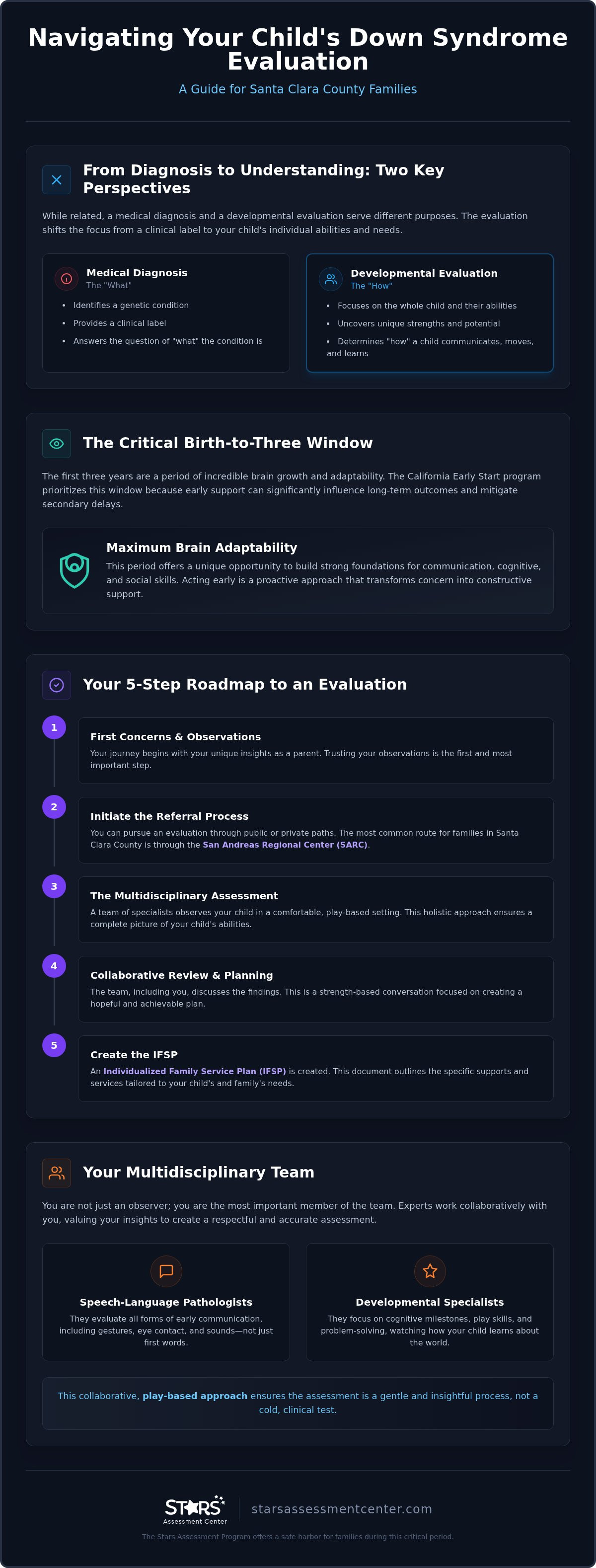
Taking the first step toward a Down syndrome evaluation Santa Clara County families need is often the hardest part of the journey. You might worry your child is too young or that their delays aren't significant enough to warrant professional attention. However, there's no such thing as being too early. If you have a gut feeling that something is different, that's reason enough to seek clarity. Proactive advocacy is your most powerful tool, whether you're in the heart of San Jose or living in Santa Cruz or Salinas. Early support doesn't just address current needs; it builds a foundation for every milestone that follows.
Step-by-Step Referral Process
Moving from concern to action is easier when you have a clear path. Follow these steps to navigate the local system with confidence:
- Step 1: Document Milestones. Keep a simple log of what your child is doing and where they seem to struggle. Note specific concerns about their communication, movement, or social responses.
- Step 2: Initiate Contact. Reach out to the San Andreas Regional Center (SARC) San Jose office or contact a private specialist like Stars Assessment Program to begin the intake.
- Step 3: Prepare for Assessment Day. Think of this as a play date with a purpose. Bring your child's favorite snacks and a few familiar toys to help them feel at ease in our safe harbor environment.
- Step 4: Collaborative Review. You'll sit down with your multidisciplinary team to discuss the findings. This is your time to ask questions and ensure the report reflects your child's true personality.
- Step 5: Create the IFSP. If eligible, you'll develop an Individualized Family Service Plan that outlines specific goals and the services needed to reach them.
Local Support and Community Resources
You don't have to navigate this process in isolation. Organizations like First 5 Santa Clara County provide excellent resources for family strengthening and early childhood health. For those seeking a community of peers, there are several local support groups in San Jose specifically for parents of children with Down syndrome. These groups offer a space to share experiences and practical advice with people who truly understand your perspective. Connecting with other families can turn a clinical process into a shared journey of hope.
If you find that language development is your primary area of concern, it's often helpful to look into a Santa Clara County Toddler Speech Evaluation. This targeted look at communication can be a vital piece of your child's overall developmental puzzle. Remember, you're the expert on your child. If you're ready to find answers and start this journey with a steady ally, you can schedule a developmental screening today to gain the clarity your family deserves.
The Stars Assessment Program: A Safe Harbor for Families
The Stars Assessment Program serves as a safe harbor for families who are often navigating the most uncertain months of their lives. As an employee-owned organization through SBHG, our commitment to your child’s success is personal. This means every specialist you meet is deeply invested in the outcome of your visit. We provide a long history of dedicated, high-quality care for infants and toddlers under the age of three. When you choose us for a Down syndrome evaluation Santa Clara County families can trust, you're gaining a partner that prioritizes clarity and hope over bureaucratic checklists. We are here to be your dedicated guide through every step of this process.
A Compassionate Evaluation Experience
We believe that a child’s natural environment is where they shine brightest. Our assessment center is designed to look and feel like a gentle playroom rather than a clinical office. During a play-based assessment, our team observes your child as they explore, interact, and discover. This non-threatening atmosphere keeps your little one comfortable. It allows us to see their true functional abilities and unique personality. We also recognize that this day can be emotionally taxing for you. Our specialists provide a steady, calming presence as you process new information. In a diverse region like ours, we offer bilingual and culturally sensitive services. We want every family in our community to feel understood and respected.
From Assessment to Action: Your Next Steps
An evaluation is only as good as the path it creates. Once the assessment is complete, we provide a comprehensive report that serves as your key to unlocking essential services. This document is a vital tool for securing a speech and language evaluation or physical therapy. It details your child's social-emotional and communicative strengths. This gives future providers a clear, strength-based starting point for their work with your family. We act as your advocate during the transition to the San Andreas Regional Center for ongoing support. Our team ensures that the findings from our multidisciplinary developmental assessment translate into a functional Individualized Family Service Plan. You don't have to wait for a milestone to be missed before you seek help. Reach out to us today to start your journey with a team that truly cares.
Empowering Your Child’s Brightest Future
Navigating the early years after a diagnosis can feel like a heavy responsibility. You've learned that a Down syndrome evaluation Santa Clara County families access is more than just a medical checkup; it's a way to see your child's whole personality and functional potential. By understanding the 45-day window for Early Start and the role of multidisciplinary teams, you're now equipped to move from a place of uncertainty to one of active advocacy. These early steps ensure that your child receives the specific social-emotional and communication supports that make a lifetime of difference.
Since 1988, we've served San Jose and the wider Santa Clara County community as a trusted ally for families. Our multidisciplinary team of infant specialists focuses on social-emotional and Down syndrome screenings in a safe, play-based environment. You don't have to walk this path alone. Contact Stars Assessment Program for a Compassionate Evaluation and let's build a roadmap together that celebrates your child's unique journey. Your proactive care today creates a foundation for a thriving tomorrow.
Frequently Asked Questions
How much does a Down syndrome evaluation cost in Santa Clara County?
Evaluations for the California Early Start program are provided at no cost to families in Santa Clara County. This includes the initial assessment, eligibility determination, and service coordination through the San Andreas Regional Center. Because we're a contractor for SARC, our evaluations for children under three are free for eligible families. This ensures that financial barriers don't stand in the way of your child's developmental progress or access to critical early intervention.
What is the wait time for a SARC assessment in San Jose?
California law requires that the evaluation and eligibility determination happen within 45 days of your first contact with the San Andreas Regional Center. This strict timeline ensures that families aren't left waiting for months during a critical developmental window. While the initial intake might take a week or two, the entire process from the referral to the first service plan meeting is completed within that mandated month and a half period.
Can my child be evaluated if they are only 6 months old?
Yes, we specialize in evaluations for infants starting from birth through age three. A Down syndrome evaluation Santa Clara County specialists conduct is designed specifically for these early months when brain plasticity is at its peak. We look at foundational milestones like head control, social smiling, and early vocalizations. Starting at six months allows us to identify your child's unique needs early and provide support before secondary delays can emerge.
What is the difference between an IFSP and an IEP?
An Individualized Family Service Plan (IFSP) is for children from birth to age three and focuses on the child's development within the context of the family. It's a collaborative roadmap that includes services like speech and physical therapy. An Individualized Education Program (IEP) starts at age three when the child transitions to the local school district. The IEP focuses primarily on educational goals and supports needed to succeed in a classroom setting.
Do I need a doctor's referral for a multidisciplinary assessment?
You don't need a formal referral from a pediatrician to begin the process with the San Andreas Regional Center. Parents in California have the right to self-refer if they have concerns about their child's development. While your doctor's input is valuable and their medical diagnosis is important, your own observations as a parent are enough to initiate a Down syndrome evaluation Santa Clara County families can access through the Early Start program.
What should I bring to my child's evaluation day?
Please bring items that help your child feel comfortable and at ease during the session. This includes favorite snacks, a comfort toy, and any medical or genetic records you haven't already shared. It's also helpful to have a list of your child's typical routines and any specific questions you have. We want the environment to feel like a safe harbor, so having familiar items nearby helps your child show us their true abilities.
How long does the actual assessment process take?
The multidisciplinary assessment usually takes between two and three hours to complete. We move at your child's pace, allowing for breaks if they become tired or hungry. During this time, our team of specialists will engage your child in play-based activities to observe their motor, communication, and social-emotional skills. This thorough approach ensures we gather a complete and accurate picture of your child's strengths and areas where they need support.
Will the evaluation happen in my home or at a center?
Evaluations can happen either in your home or at a specialized assessment center. Many families prefer the center environment because it provides access to a wide range of developmental tools and a multidisciplinary team in one location. Our center in Santa Clara County is designed to be warm and non-clinical, ensuring it feels like a playroom rather than a medical office. We'll work with you to determine the most supportive setting for your child.


