You're at a local park in San Jose, watching other toddlers point and babble while your little one remains quiet, and you feel a familiar knot of worry in your stomach. It's natural to feel anxious when milestones don't seem to align with what you see in playgroups or on the latest developmental checklists. You aren't alone in this feeling, and your concern is a reflection of your deep love for your child. Seeking a speech delay evaluation infants can feel like a big step, but it's often the most empowering choice a parent can make.
We believe that an evaluation isn't a "test" to pass or fail. Instead, it's a multidisciplinary roadmap designed to unlock your child's unique communication style. In the following sections, you'll discover how to identify specific red flags and what to expect during a professional assessment. We'll also provide a clear path to local support through California's Early Start program, ensuring your family has the resources you need right here in Santa Clara County.
Key Takeaways
- Learn the difference between speech and language development and why early communication is the foundation for your child's social-emotional health.
- Identify specific red flags, such as a lack of babbling or limited joint attention, that indicate when it's time to seek expert guidance.
- Understand what happens during a speech delay evaluation infants and how a multidisciplinary team looks at the whole child rather than just isolated sounds.
- Navigate the local referral process in Santa Clara County with confidence, from talking to your pediatrician to connecting with the San Andreas Regional Center.
- Discover how a gentle, family-centered approach to assessment can replace uncertainty with a clear, supportive roadmap for your child's future.
Understanding Speech and Language Development in Your Infant
Parents often wait for that magical first word to mark the start of communication. However, the journey begins the moment your baby first looks into your eyes or reacts to the sound of your voice. These early interactions are the building blocks of social-emotional growth. When we discuss a speech delay evaluation infants, we're looking at much more than just a word count. We're observing how your child connects with the world around them through sounds, expressions, and movements.
Speech vs. Language: What’s the Difference?
It's helpful to distinguish between two terms that are often used interchangeably. Speech refers to the physical production of sounds. It involves the complex coordination of the lips, tongue, and breath to create babbles and, eventually, words. Language, on the other hand, is the system we use to share thoughts and understand others. A child might have the physical ability to make sounds but struggle to understand what you're saying or how to use those sounds to request a snack. Understanding Language Delay is vital because an infant can experience a lag in one area while excelling in the other. Recognizing this distinction helps us tailor support to your child's specific needs.
Communication Milestones: 0 to 12 Months
Monitoring milestones helps us provide a gentle roadmap for your child's progress. While every baby develops at their own pace, there are general patterns we look for during the first year of life:
- 0 to 4 Months: Your baby should start cooing and making "ooh" and "aah" sounds. They'll often turn their head toward your voice or startle at loud noises.
- 6 to 9 Months: This is the season of "vocal play." You'll hear strings of babbles like "ba-ba-ba" or "da-da-da." They also begin to recognize their name and common words like "bottle" or "no."
- 10 to 12 Months: By their first birthday, most infants use intentional gestures, such as waving "bye-bye" or pointing at a toy they want. This period is the bridge to the 15-month milestone, where many children start trying to say one or two words besides "mama" or "dada."
These "pre-linguistic" skills, like eye contact and joint attention, are the true precursors to talking. If an infant isn't yet babbling or gesturing, a speech delay evaluation infants can help identify if they need a little extra support to bridge that gap. Unlike preschool assessments that focus heavily on vocabulary size and sentence structure, infant evaluations are much more about the foundations of communication. We look at how your baby plays, how they engage with you, and how they express their needs without words. This holistic view ensures we support the whole child from the very beginning, providing clarity and peace of mind for your family.
Identifying Red Flags: When to Seek a Speech Delay Evaluation
If you've ever felt that your child is "too quiet," you aren't alone. While some babies are naturally more observant, a consistent lack of vocalization is often an early signal that deserves a closer look. A speech delay evaluation infants is a proactive step that replaces uncertainty with a clear plan. Many families are told to "wait and see," but this approach can miss the most critical window for brain development. Research indicates that untreated delays can lead to persistent challenges in 40% to 60% of affected children. Being proactive today creates a much smoother path for your child's future.
Recognizing these early signs isn't about finding fault; it's about understanding how your child connects with you. According to this evidence-based review of speech delay evaluation, early screening is the most effective way to address potential developmental gaps. If you're feeling uncertain, reaching out to a gentle, family-centered team can provide the clarity and reassurance you need.
Top Red Flags by Age Range
- By 6 months: Your baby isn't making vowel sounds like "ah" or "oh" and doesn't seem to respond to the sound of their own name.
- By 9 months: You don't see back-and-forth gestures, such as reaching for you, or a lack of social smiling during play.
- By 12 months: Your little one isn't using specific sounds like "mama" or "dada" and isn't shaking their head for "no" or pointing to things they want.
Common Causes of Early Communication Delays
Understanding the "why" behind a delay helps us determine the right support. Physical factors are often the first place we look. Chronic ear infections or undiagnosed hearing loss can make it difficult for an infant to process sounds correctly. When a baby can't hear clearly, they can't mimic the sounds necessary for speech.
We also consider neurological factors during a speech delay evaluation infants. This includes specialized screenings for Autism or Down syndrome to ensure we understand your child's unique developmental profile. In other cases, environmental factors play a role. Communication thrives on "serve and return" interactions, where a caregiver responds to a baby's cues. If these interactions are limited, a baby might need extra encouragement to find their voice. Regardless of the cause, identifying it early allows us to build a bridge toward better communication.
The Multidisciplinary Approach to Speech Delay Evaluation
When you first consider a speech delay evaluation infants, you might expect a simple hearing test or a word-count checklist. However, communication is a complex skill that doesn't develop in isolation. It's deeply intertwined with how your baby processes information, manages their emotions, and interacts with others. This is why a multidisciplinary approach is so valuable. By looking at the whole child rather than just their vocalizations, we can create a much more accurate and helpful roadmap for your family. A Speech-Language Pathologist (SLP) is an essential part of this process, but they are just one piece of the puzzle.
Assessing social-emotional and cognitive skills at the same time allows us to see if a delay in talking is a standalone issue or part of a broader developmental pattern. This holistic view prevents us from missing underlying needs that a single-focus assessment might overlook. It's about seeing the "why" behind the silence, whether it's related to processing speed, social engagement, or physical coordination. This collaborative method ensures that the support we recommend is as unique as your child.
Who is on the Evaluation Team?
A multidisciplinary team brings together specialists who look at your child through different lenses. Speech-Language Pathologists focus on the mechanics of communication, such as sound production and understanding language. Developmental Specialists assess cognitive growth, looking at how your infant solves problems or explores their environment. In many cases, Social Workers or Psychologists are also involved. Their role is to support the family unit, ensuring that you feel heard and have the resources you need to navigate this journey with confidence.
Play-Based Assessment: The Gold Standard for Infants
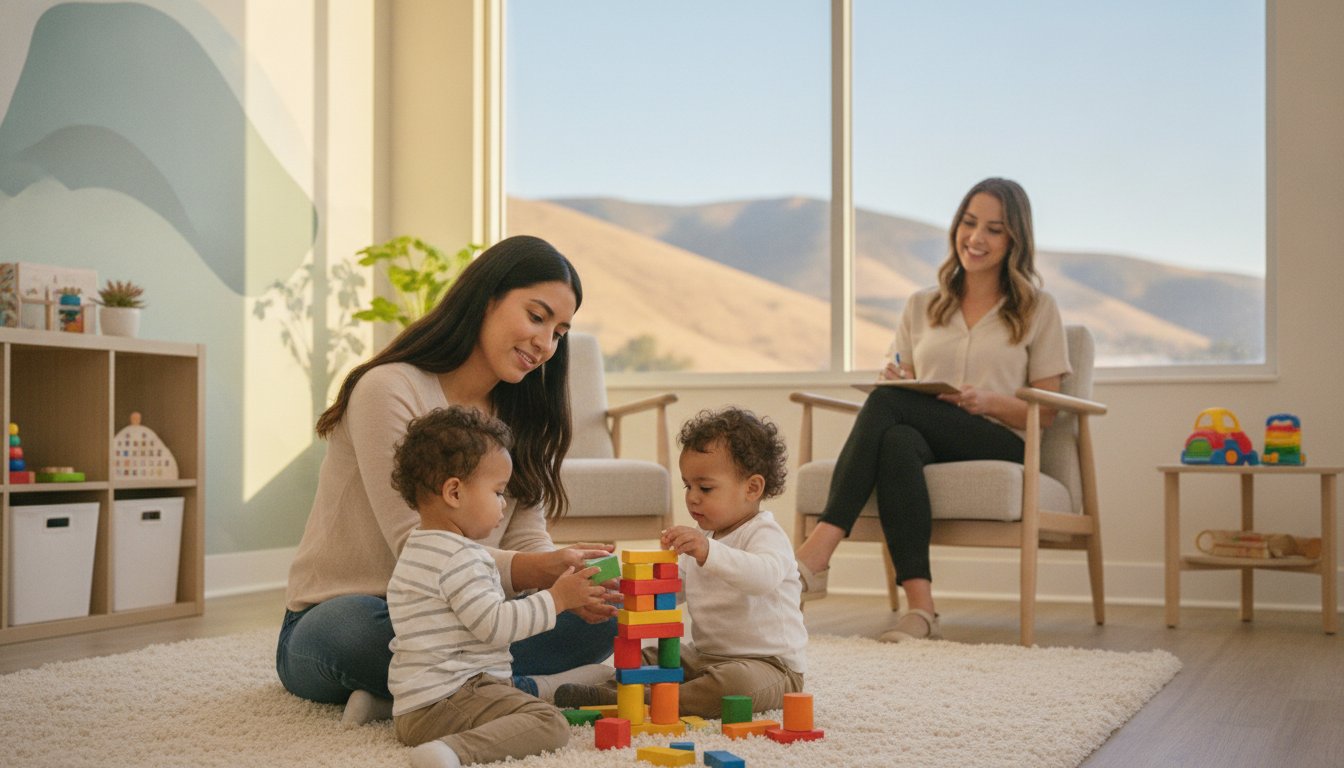
You won't see "testing" tools or clinical exams during an infant evaluation. Instead, we use toys, games, and gentle interactions. This play-based approach is the most effective way to see a baby's true abilities. We observe how your infant reaches for a block, how they track a moving toy, and how they look to you for a reaction. These moments tell us more about their communication potential than any standardized test could.
During this process, you are the most important person in the room. You're the expert on your child's daily life, and your insights are vital. We rely on parent interviews to understand what happens at home, from how your baby requests a bottle to how they settle down for a nap. This partnership between parents and professionals is what makes a speech delay evaluation infants so effective. It transforms a clinical process into a supportive, family-centered conversation about your child's bright future.

Navigating the Evaluation Process in Santa Clara County
Navigating the early intervention system in California often feels like learning a new language, but the path is well-defined for families in San Jose or Salinas. It begins with the California Early Start program, which serves children from birth to 36 months. In our region, the San Andreas Regional Center (SARC) is the primary hub for coordinating these vital services. A speech delay evaluation infants through this state-funded system is provided at no cost to families for the initial assessment and service coordination. This ensures that every child in Santa Clara County has access to the professional insights they need regardless of their financial situation.
Under California law, your child may be eligible for services if they show a developmental delay of at least 25% in one or more areas, such as communication, cognitive, or social-emotional growth. Knowing your rights under the Early Start program empowers you to be the best advocate for your little one. While the evaluation itself is free, public or private insurance is often used for medically necessary services, and an Annual Family Program Fee may be assessed in specific circumstances. Understanding these logistical details early on lets you focus your energy on supporting your infant's unique communication journey.
Step-by-Step: From Concern to Support
The path to support is methodical and designed to be family-centered. The first step is documenting what you see at home. If your child isn't meeting the communication milestones we've discussed, bring these observations to your pediatrician. They can provide a referral to a multidisciplinary center. In our community, the Stars Assessment Program is a trusted partner for families seeking a speech delay evaluation infants to address developmental concerns. On the evaluation day, you'll meet with a team of specialists who value your perspective as the expert on your child. If your child is found eligible, the next step is creating an Individualized Family Service Plan (IFSP), which acts as a collaborative roadmap for your child's success.
Local Resources for Families in Santa Clara and Beyond
You aren't alone on this journey. There are dedicated parent support groups in Milpitas and Gilroy where you can connect with other families who truly understand your experience. Beyond general support, our community offers specialized screenings for Autism and Down syndrome, ensuring that every child's unique needs are identified with precision. If you're ready to move from uncertainty toward a clear plan, you can contact our team to begin the referral process and find the local support your family deserves.
How Stars Assessment Program Supports Your Family’s Journey
At Stars Assessment Program, we understand that a speech delay evaluation infants is more than just a clinical appointment. It's a pivotal moment for your family. We've designed our process to be a "safe harbor," where the focus is on understanding your child's unique strengths rather than just identifying deficits. Families in San Jose, Santa Cruz, and Salinas turn to us because we provide a calming presence during a time of uncertainty. Our goal is to replace your worry with a clear, actionable path forward that brings clarity and hope to your home.
We look at the "whole child" because communication doesn't happen in a vacuum. As we discussed in earlier sections, a child's social-emotional well-being and cognitive development are the foundations upon which speech is built. By assessing these areas together, our multidisciplinary team provides the comprehensive picture you need to make informed decisions. This isn't a distant or bureaucratic process. It's a partnership where your voice as a parent is prioritized and respected throughout the entire speech delay evaluation infants.
A Safe Harbor for Your Child's Growth
Our commitment to a gentle, non-alarmist approach is what sets us apart. We specialize in screenings for infants from birth to age three, ensuring that early intervention is accessible and non-intimidating for both the child and the parents. Local families trust our multidisciplinary model because we prioritize the comfort of the infant. We use familiar, play-based interactions that feel like a natural afternoon of discovery rather than a series of clinical tests. This environment allows your little one to show us their true potential, giving us the most accurate data to support their growth.
Starting the Conversation Today
Reaching out for help is a sign of incredible advocacy for your child. If you've observed the red flags mentioned earlier, such as a lack of babbling by nine months or a lack of intentional gestures by their first birthday, the next step is simple. You can contact us directly to discuss a developmental screening. We're here to guide you through the referral process and ensure you feel supported from the very first phone call.
When you come for your infant's first assessment, bringing familiar toys or a favorite snack can help them feel at home in our center. We also recommend having your pediatrician's contact information and any notes you've taken on your child's milestones ready to share with our team. Every child's journey is different, but no family should have to walk it alone. We're here to provide the expertise, empathy, and local support you need to help your child find their voice. Contact the Stars Assessment Program for a compassionate evaluation and take the first step toward your child's personalized developmental roadmap today.
Empowering Your Child’s Communication Future
Watching your child grow is a journey filled with wonder, and noticing a delay in their communication doesn't change their incredible potential. By understanding the early milestones and recognizing when to seek expert guidance, you’ve already taken the most important step in supporting their development. A speech delay evaluation infants is not a final destination; it’s a helpful beginning that provides your family with a clear, supportive roadmap for the years ahead.
Our specialized multidisciplinary team focuses exclusively on children under three, offering a family-centered approach that prioritizes your child's comfort. We're proud to serve families throughout Santa Clara, Santa Cruz, and Monterey Counties with the empathy and expertise you deserve. You have the power to turn uncertainty into a proactive plan for growth. Schedule a Compassionate Multidisciplinary Evaluation for Your Child today to discover the local support available to you. Your child’s voice is waiting to be heard, and we’re honored to help you unlock it.
Frequently Asked Questions
What is the difference between a speech delay and a language delay in infants?
Speech refers to the physical mechanics of producing sounds, like cooing and babbling. Language is the broader system your baby uses to understand instructions and share their thoughts with you. An infant might have a speech delay if their sounds aren't clear, while a language delay involves difficulty grasping the meaning of words or using gestures to communicate.
When should I be concerned if my 12-month-old isn't talking yet?
You don't need to worry about a lack of words alone at this age, but you should look for other communication markers. By 12 months, your baby should be responding to their name, using social smiles, and pointing to objects they want. If they aren't using these non-verbal cues, it's a good idea to discuss your concerns with a professional.
How do I get a speech evaluation for my baby in Santa Clara County?
The first step is contacting the San Andreas Regional Center (SARC) or your pediatrician to request a speech delay evaluation infants. In our region, the Stars Assessment Program works with families to provide these multidisciplinary assessments. This ensures that infants in San Jose and Salinas receive the early intervention support they're entitled to under California's Early Start program.
What happens during a multidisciplinary developmental assessment?
This assessment is a collaborative observation where specialists look at your child's communication, cognitive, and social skills through play. Instead of clinical tests, we use toys and gentle interactions to see how your baby solves problems and engages with others. It’s a low-stress environment designed to show us your child’s true abilities and strengths.
Can a hearing problem cause a speech delay in my infant?
Yes, hearing is the foundation for learning how to produce sounds. If an infant has chronic ear infections or undiagnosed hearing loss, they can't accurately mimic the speech they hear around them. Identifying these physical barriers early is a standard part of our evaluation process to ensure your child has a clear path to communication.
Is my child too young for a speech evaluation if they are under 18 months?
No child is too young for support, as the Early Start program serves infants from birth. If you notice a lag in milestones like babbling or responding to sounds, seeking a speech delay evaluation infants early is highly beneficial. Early intervention takes advantage of the rapid brain development that occurs well before a child’s second birthday.
Will my child grow out of a speech delay on their own?
While some children are "late bloomers," many require targeted support to bridge developmental gaps. Waiting can lead to frustration for the child and missed opportunities for early learning. Professional guidance helps you determine if your little one just needs more time or if specific strategies could help them find their voice sooner.
How does the Stars Assessment Program help families in San Jose?
The Stars Assessment Program provides a supportive, local team that specializes in the unique needs of children under three. We offer a gentle, multidisciplinary approach that looks at the whole child, not just their speech. By serving families in San Jose and surrounding areas, we provide the clarity and specialized screenings needed to create a successful developmental roadmap.


