As a parent, you are the world’s leading expert on your child. You notice the subtle shifts in their babbling, the way their eyes light up at a familiar face, and the determination in their first wobbly steps. Sometimes, you may also notice moments of hesitation or patterns that leave you with a gentle, persistent question: "Is my child on track?"
This question is a natural part of parenting, born from a place of deep love and care. In a world of milestone charts and endless advice, it’s easy to feel overwhelmed or anxious. But what if that question wasn't a source of worry, but the first step toward profound understanding and support? This is the promise of early developmental assessments—a compassionate, collaborative process designed not to find faults, but to discover your child’s unique strengths and provide a clear path forward.
Especially during the first 1,000 days of life, when your child's brain is developing at a phenomenal rate, understanding their specific needs is one of the most powerful gifts you can give them. This guide will walk you through the life-changing benefits of early developmental assessment, demystifying the process and empowering you with the clarity and confidence to help your child thrive.
What is Early Developmental Assessment for Infants and Toddlers?
An early developmental assessment is a gentle, proactive check-in on how your child is growing, learning, and interacting with the world around them. It is a partnership between you and a team of developmental specialists, designed to give you a comprehensive understanding of your child’s unique developmental profile.
- A Proactive Check-In: It’s a way to explore how your child is learning to communicate, solve simple problems, use their body, and connect with others.
- Focus on the 'First 1,000 Days': This process is most impactful from birth to age three, a critical period of rapid brain development where support can make the biggest difference.
- A Collaborative Partnership: It’s not a test your child can pass or fail. It is a warm, play-based observation where your insights as a parent are valued as essential pieces of the puzzle.
- More Than Milestone Watching: While milestone checklists are helpful, a professional assessment provides a deeper, more holistic view of your child’s individual journey.
The Difference Between Screening, Assessment, and Evaluation
You may hear these terms used interchangeably, but they represent different steps in understanding your child’s development. Knowing the difference can help you navigate the journey with clarity.
- Screening as the 'First Look': A developmental screening is often a quick check, like a short questionnaire you might fill out at your pediatrician’s office. It’s designed to see if there are any potential areas of concern that warrant a closer look. Screenings are an important first step, but they don’t provide a full picture.
- Assessment and Evaluation as the 'Deep Dive': A developmental assessment or evaluation is the comprehensive, in-depth process that follows a screening if concerns are raised. This is where a multidisciplinary team of specialists (such as speech-language pathologists and early childhood development experts) observes your child through play. The goal is to understand your child's specific strengths and challenges, creating a detailed profile of their developmental needs.
- Why Both Steps Matter: A screening can signal that it’s time to pay closer attention, while a thorough assessment provides the clear, detailed roadmap you need to provide targeted support and access early intervention services.
Key Areas Explored During an Assessment
A multidisciplinary assessment looks at your child as a whole person, understanding that all areas of development are interconnected. The team will gently and playfully explore several key domains:
- Communication: This includes how your child expresses their needs (using sounds, gestures, or words) and how they understand what is said to them.
- Social-Emotional: This focuses on how your child interacts with you and others, shows emotions, and begins to regulate their feelings. It’s the foundation for building healthy relationships.
- Cognitive and Physical: The team observes your child's problem-solving skills, curiosity, and memory, as well as their fine and gross motor skills—from picking up a small toy to learning to walk and run.
The Core Benefits of Early Developmental Assessment: Why Sooner is Better
When you have a question about your child's development, seeking an assessment sooner rather than later can be truly life-changing. It’s not about rushing to find a problem; it’s about proactively creating an environment where your child has every opportunity to flourish. The benefits are profound and long-lasting, for both your child and your entire family.
- Maximizes 'Neuroplasticity': The infant and toddler brain is incredibly adaptable. Early support leverages this period of peak neuroplasticity, making it easier for the brain to build strong new neural connections that support learning and skill development.
- Empowers Parents: An assessment gives you a clear vocabulary to describe your child's needs and advocate for them. It replaces confusion with a concrete plan, transforming you from a worried observer into an empowered partner in their growth.
- Reduces Future Stress: By addressing small hurdles before they become larger challenges, early assessment and intervention can prevent years of frustration for your child and your family. It lays a stronger foundation for future learning and social success.
- Unlocks Vital Services: In California, a professional assessment is the key to determining eligibility for state-funded early intervention services. These services are provided at no cost to eligible families and are designed to give your child the best possible start.
The Power of Early Intervention
The ultimate goal of an early developmental assessment is to connect your child with early intervention services if they are needed. Research overwhelmingly shows that providing support before age three leads to significantly better long-term outcomes in communication, social skills, and school readiness. In fact, an incredible 85% of brain development occurs before a child’s third birthday. When a child with a language delay receives an early speech and language evaluation, for example, they can learn new ways to communicate, reducing the frustration that often leads to challenging behaviors.
Social and Emotional Foundations
One of the most crucial benefits of early assessment is its focus on social-emotional health. Identifying these delays early helps support healthy attachment, bonding, and the development of play skills. For children who may have conditions like Autism or Down syndrome, specialized assessments can identify early signs and connect families with tailored support that honors their child’s unique way of relating to the world. By understanding your child’s specific social and emotional style, you can create an environment that builds their confidence and helps them feel secure, seen, and celebrated.
Addressing the 'Wait and See' Approach: Why a Professional Assessment Matters
It is completely natural to hope that your child will simply "grow out of" a potential delay. Friends, family, and even some professionals might advise a "wait and see" approach. This instinct comes from a place of love and optimism. However, while some children are simply "late bloomers," waiting can sometimes mean missing a critical window for the most effective support.
- Validating Your Instincts: A professional assessment honors your parental intuition. If you feel something is different, having it explored by experts can either provide reassurance that all is well or validate your concerns with a clear plan.
- Understanding 'Late Blooming': Sometimes, what looks like "late blooming" can mask an underlying need that, if addressed, could help your child progress more easily and with less frustration.
- Reframing the 'Label': Many parents fear that an assessment will lead to a "label." It’s more helpful to see it as a "key." This key can unlock a world of specialized resources, understanding from educators, and access to services designed specifically to help your child thrive.
- The Peace of Mind of Knowing: The uncertainty of not knowing is often more stressful than the reality. An assessment provides clarity, replacing worry with actionable steps and the peace of mind that comes from knowing exactly how to help your child.
The Risks of Delaying an Assessment
While waiting can feel like the safest option, it comes with potential risks. The most significant is missing the critical window for California's "Early Start" program, which provides services only for children from birth to age three. Delaying an assessment can also lead to increased family stress as communication or behavioral needs go unmet. Over time, small developmental gaps can have a cumulative effect, potentially impacting a child’s readiness for preschool and beyond. A proactive approach helps build a strong foundation, making later transitions smoother and more successful.
Reframing the Assessment Experience
A developmental assessment doesn’t have to be a cold or clinical experience. At its best, it is a warm and supportive process that empowers your family. Think of it not as a search for deficits, but as a celebration of everything your child can do. The goal is to understand their unique profile of strengths so you can build on them. By partnering with experts who see your child's incredible potential, you can move past the fear of the unknown and embrace the journey with confidence and a community of support behind you.

What to Expect During and After a Developmental Evaluation
Knowing what the evaluation day will look like can help ease any anxiety you or your child might feel. The process is designed to be as comfortable and natural as possible, with a focus on observing your child in a play-based, supportive environment. You are a critical part of the team every step of the way.
- Initial Intake and Conversation: The process begins with a conversation. You’ll share your unique observations, your child’s history, and your family's goals. You are the expert on your child, and your insights are the foundation of the entire evaluation.
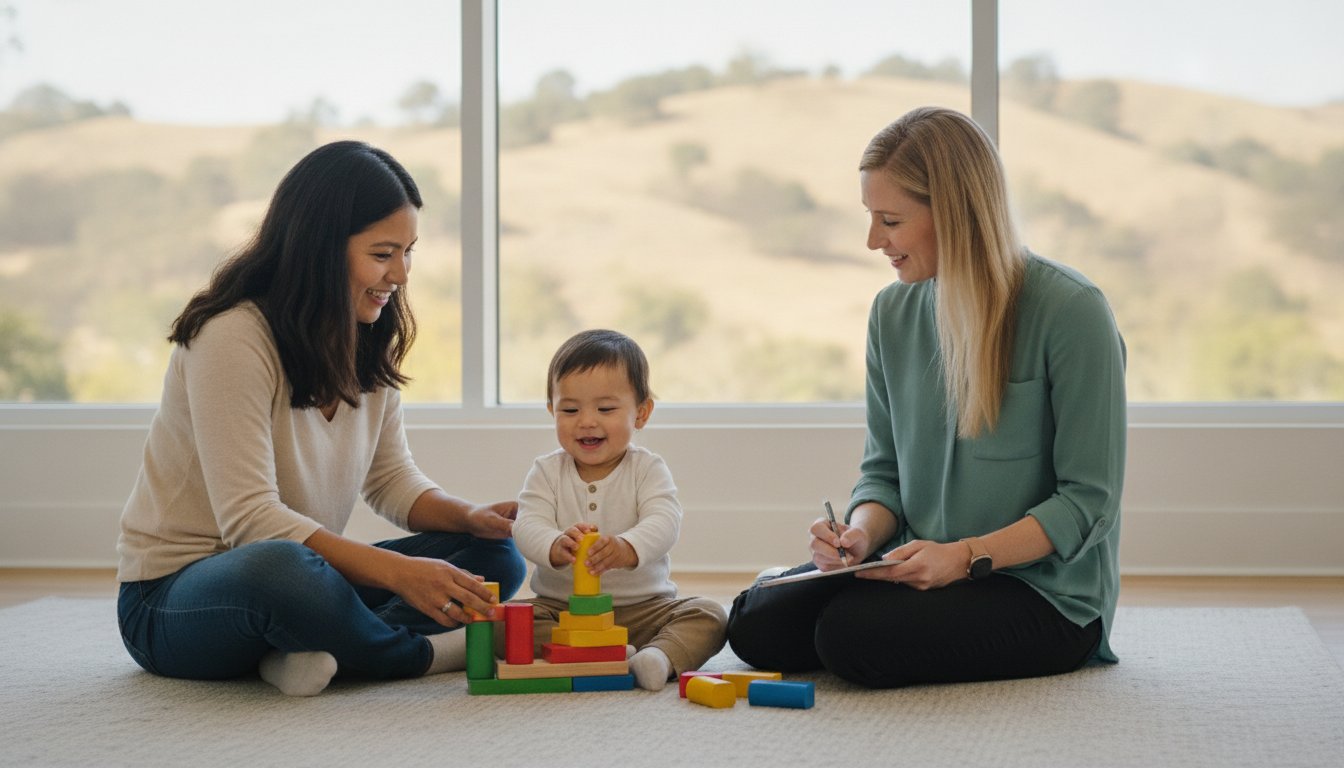
- The Multidisciplinary Observation: This is the heart of the evaluation. A team of specialists will engage your child in play. They will use age-appropriate toys and activities to observe how your child communicates, interacts, moves, and solves problems. It should feel like a structured, friendly playtime.
- Collaborative Review of Findings: After the observation, the team will meet with you to discuss their findings in clear, easy-to-understand language. They will connect their professional observations with the insights you shared, creating a holistic picture of your child.
- Creating a Personalized Plan: The evaluation concludes with a clear plan for the next steps. Whether your child is meeting all their milestones or would benefit from support, you will leave with actionable recommendations and referrals to local services.
The Multidisciplinary Team Approach
One of the greatest benefits of a formal evaluation is the multidisciplinary team. Instead of seeing just one specialist, your child is observed by several experts at once, such as a speech-language pathologist, an early childhood specialist, and a social-emotional expert. This provides a truly holistic view, ensuring no part of your child’s development is overlooked. For children with complex needs or possible signs of Autism or Down syndrome, this team-based approach is essential for creating a comprehensive and accurate developmental profile.
Navigating Local Support in Santa Clara County
A key outcome of an evaluation is connecting you to local resources. The results provide the documentation needed for referrals to vital organizations like the San Andreas Regional Center, which is the primary entry point for California’s Early Start program for families in our community. The assessment team can also connect you with local family resource centers in San Jose, Milpitas, and surrounding areas. Programs like Stars Assessment Program act as a crucial bridge, providing the clarity needed to navigate and access these life-changing services.
How Stars Assessment Program Supports Families in Santa Clara County
At Stars Assessment Program, we understand that the journey of early childhood development is filled with both joy and uncertainty. Our entire approach is built around providing a safe harbor for families, where you can find not just expert answers, but also compassion, partnership, and genuine care.
- A Family-Centered Mission: We treat every child and family who walks through our doors as if they were our own. Your peace of mind is our highest priority.
- Specialized Expertise: Our multidisciplinary team specializes exclusively in the unique developmental needs of infants and toddlers from birth to age three.
- Deep Community Roots: Serving families from Salinas to Morgan Hill and across Santa Clara County, we have a deep understanding of the local resources available to support you.
- A Supportive Environment: We have carefully designed our centers to be warm, welcoming, and non-clinical, ensuring both children and parents feel at ease from the moment they arrive.
Our Multidisciplinary Assessment Process
Our comprehensive assessments, including our detailed social-emotional and speech and language evaluations, are designed to give you the complete picture you need. As an employee-owned organization (ESOP), our team is personally invested in providing the highest quality of care and commitment to every family. We are driven by a shared mission: to provide the clarity parents need to navigate their child’s early years with confidence and a clear path forward.
Your Partners in Growth
We don’t just provide a report; we provide a partnership. Our goal is to empower you with understanding and connect you to a community of support that will walk alongside you. If you have questions about your child’s development, you are not alone. We are here to help.
Contact our San Jose-based team to schedule a compassionate assessment for your child today.
Frequently Asked Questions
What are the first signs that my child might need a developmental assessment?
Signs can be subtle and vary widely. You might consider an assessment if you notice your child isn't meeting communication milestones (like babbling, pointing, or using single words), has difficulty making eye contact, doesn't respond to their name, shows limited interest in playing with others, or has significant challenges with motor skills like sitting up or crawling. If you're looking for more specific examples, you can review a resource like our 'Is My Toddler Developmentally Delayed?' checklist. Ultimately, trusting your parental instinct is key; if you have a persistent concern, it's always worth exploring.
Is a developmental assessment the same as a medical diagnosis?
Not exactly. A developmental assessment is focused on identifying a child's functional strengths and challenges to determine eligibility for early intervention services. While it can identify signs consistent with conditions like Autism Spectrum Disorder, the primary goal is to create a profile of developmental needs. A formal medical diagnosis is typically made by a physician, such as a developmental pediatrician or neurologist, though the assessment report is a critical piece of that diagnostic process.
How long does a multidisciplinary developmental assessment take?
A comprehensive assessment typically takes between 90 minutes and two hours. This includes the initial conversation with you, the play-based observation of your child with the team, and the collaborative review of the findings and next steps. The process is designed to be thorough but not overwhelming for a young child.
Will my child be labeled for life if they have a developmental delay?
This is a common and understandable fear. It's more helpful to view the outcome not as a "label," but as a "key." An identification of a developmental delay is a tool that unlocks access to essential, often free, early intervention services that can make a profound difference. In the world of early childhood, these classifications are used to provide support, not to define a child's future potential. Children grow and change, and early support is the best way to help them reach their unique potential.
What should I bring to my child's first assessment in Santa Clara County?
You should bring any previous reports from other specialists, your child’s health insurance card, and a list of any questions or concerns you have. It's also a good idea to bring snacks, a drink, and a favorite comfort toy for your child to help them feel secure. Most importantly, bring your own invaluable expertise—your observations and insights as their parent are the most critical part of the process.
Can an assessment help if I suspect my child has Autism or Down syndrome?
Yes, absolutely. A multidisciplinary developmental assessment is a crucial step in understanding the unique developmental profile of children with suspected or known conditions like Autism or Down syndrome. The team has specialized training to identify the early signs and create a tailored plan that builds on your child's specific strengths while addressing their unique challenges.
What happens if the assessment shows my child is meeting their milestones?
This is a wonderful outcome that provides incredible peace of mind! If the assessment confirms your child is developing on track, the team will provide you with this reassurance. They can also offer tips and age-appropriate activities to continue supporting your child's healthy development at home, empowering you with the confidence that you are on the right path.
How do I explain the assessment process to my toddler?
For a toddler, it's best to keep the explanation simple and positive. You can say something like, "We're going to a new playroom to meet some nice people who want to play with you!" Frame it as a fun and special activity. Your own calm and reassuring demeanor will be the most important signal to your child that it is a safe and positive experience.


